







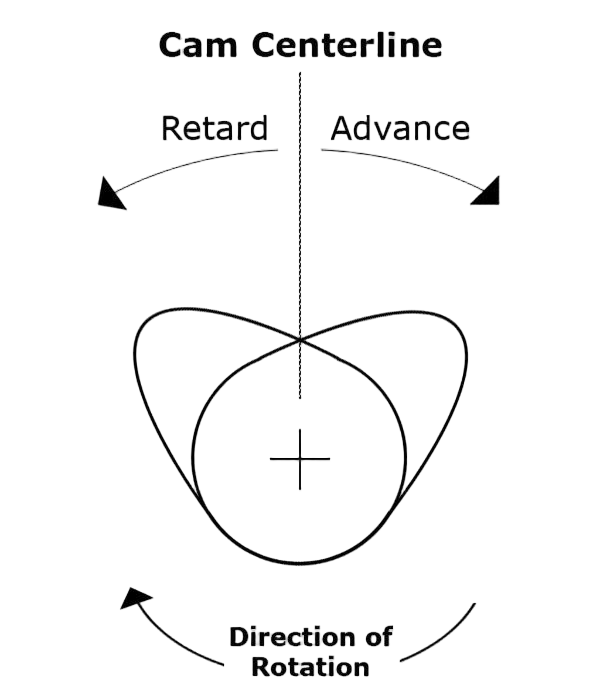
To advance or retard a
camshaft is to change the alignment between the
camshaft and the crankshaft.
When a cam is installed
"straight-up," the imaginary centerlines of the
two shafts line up exactly. Advancing or
retarding the cam pushes the centerline of the
camshaft to one side or the other of the
crankshaft centerline. This changes the Timing
of the valve opening and closing events, in
relation to the position of the piston in the
cylinder.
¡¡
¡¡
¡¡
¡¡
How is it measured?
1.
Find the lobe centerline
in relation to the
piston's position in the
cylinder.
¡¡
a.
This
is known as "degreeing
the camshaft."
¡¡
b.
This
should be done when
building an engine or
replacing a camshaft.
¡¡
c.
Follow
this link for the
process to Degree the
Camshaft.
2.
Compare the centerline
to the value listed on
the Cam Card.
¡¡
a.
If
different than the
listed value, the cam is
either advanced or
retarded.
¡¡
b.
For
example, if the intake
centerline is listed as
107¡ã and you find it at
103¡ã, the cam is
advanced 4¡ã.
Some
camshafts are designed with
"ground-in" advance. Follow this
link to learn more about
Ground-In Advance
¡¡
¡¡
¡¡
¡¡
How does it affect
performance?
Advancing
or retarding the cam will move
the Torque curve higher or lower
in the rpm range.
¡¡
¡¡
Advance
Retard
General Effect
Improves low-end
power and
throttle
response
Improves power
at higher rpm's
Intake Valve
Opening Event
Happens sooner
Happens later
Piston to Valve
Clearance
Decreases intake
valve clearance
Increases intake
valve clearance
Moving 4¡ã
Causes...
Peak torque
about 200 rpm
sooner
Peak torque
about 200 rpm
later
¡¡
¡¡
Quick Links
Contact Info
Welcome to visit us
YuHuan
NewCams
Machinery
Manufacture Co.,Ltd.
We complete every process carefully and
provide the best service for
each vehicle.