





Camshaft
Top Questions
What is the role of a camshaft in an internal-combustion
engine?
The camshaft actuates the intake and exhaust valves of piston cylinders, ensuring valve timing is synchronized with piston movement for an engine to run smoothly.
The camshaft actuates the intake and exhaust valves of piston cylinders, ensuring valve timing is synchronized with piston movement for an engine to run smoothly.
How does the camshaft interact with the crankshaft in a
four-stroke engine?
The camshaft is linked to the crankshaft by gears, chains, or a belt, rotating at half the speed of the crankshaft and coordinating valve timing with piston movement.
The camshaft is linked to the crankshaft by gears, chains, or a belt, rotating at half the speed of the crankshaft and coordinating valve timing with piston movement.
What are the four strokes in a four-stroke cycle?
The four-stroke cycle comprises the intake stroke, compression stroke, power stroke, and exhaust stroke.
The four-stroke cycle comprises the intake stroke, compression stroke, power stroke, and exhaust stroke.
What are the names of the different types of camshafts?
Different types of camshafts are: solid flat tappet, hydraulic flat tappet, solid roller, and hydraulic roller.
Different types of camshafts are: solid flat tappet, hydraulic flat tappet, solid roller, and hydraulic roller.
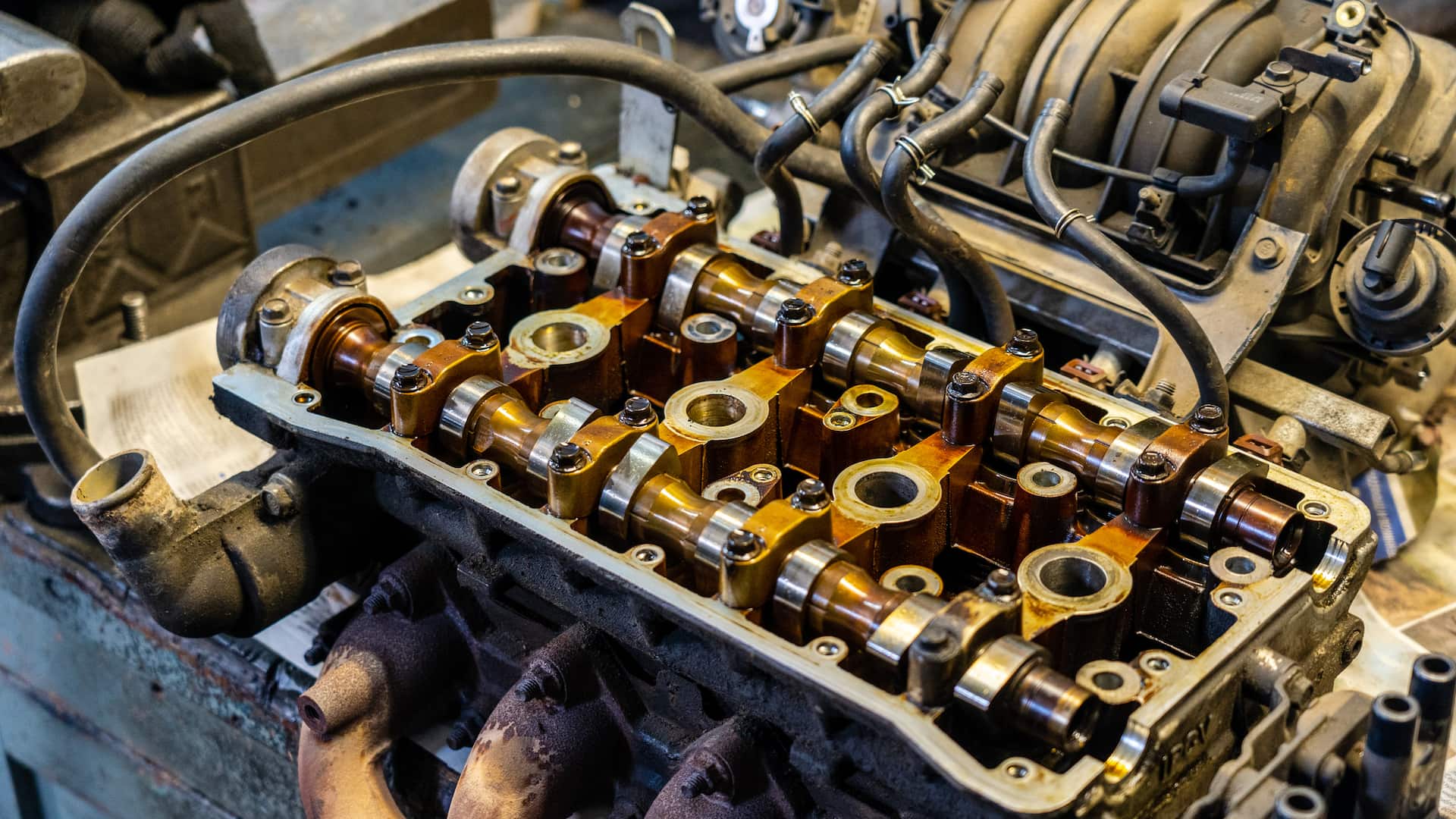
camshaft, in internal-combustion engines, a rotating shaft with
attached disks of irregular shape (the cams), which actuate the
intake and exhaust valves of a piston and cylinder. The cams and
the camshaft are usually formed as a unit, with the cams set at
angles to open and close the valves in a prescribed sequence as
the cams rotate. A separate camshaft for each row of cylinders
is driven by gears or chains from the crankshaft. Some engine
designs feature two camshafts for each row of cylinders.
Function
The camshaft is mechanically linked to the crankshaft by gears
or through chains or a belt so that valve timing (controlled by
the camshaft) remains synchronized with piston movement (which
drives the crankshaft). The camshaft usually rotates at half the
speed of the crankshaft in a four-stroke engine.
As the piston moves up and down, the camshaft opens and closes
inlet and outlet valves. This precise coordination is critical
for an engine to run smoothly through a typical four-stroke
cycle.
The four-stroke cycle
Intake stroke: The opening of a piston cylinder’s inlet
valve allows the air-gas mixture to enter the cylinder as the
piston moves down in the cylinder.
Compression stroke: The inlet valve closes as the piston
rises, compressing the air-gas mixture.
Power stroke: A spark plug at the top of the cylinder
ignites the mixture. The force of the generated explosion pushes
the piston down. This is where the engine’s power comes from.
Exhaust stroke: The camshaft opens the cylinder’s exhaust
valve, allowing the gases to exit the cylinder as the piston
comes back up.
Since the camshaft moves at half the speed of the crankshaft,
one four-stroke cycle is completed for every two revolutions of
the crankshaft.
Types of camshafts
There are four types of camshafts based on the design of
the parts connecting the cam lobes to the valves.
• Solid flat tappet: This is a traditional design
in which the cam pushes directly on a flat lifter. It
works well at high speeds but makes more noise and needs
regular adjustment to maintain the correct gap (lash).
• Hydraulic flat tappet: Though similar to the
solid flat type, the hydraulic flat has a small
oil-filled part inside that automatically keeps the lash
correct. This makes it quieter, smoother, and easier to
maintain.
• Solid roller: Instead of a flat surface, the
lifter has a tiny roller wheel that rides on the cam.
This reduces friction and lets the engine use additional
cams with more flared-out head curves for more power.
Like the solid flat type, it needs regular adjustments.
• Hydraulic roller: This combines the roller
wheel, with its reduced friction and greater power
potential, with a self-adjusting oil system, which
obviates the need for manual lash checks. This design is
quiet, durable, and low-maintenance.
Camshafts can also be classified based on the camshaft’s
location relative to the valves and how its motion
reaches them:
Cam-in-block (overhead valve): In this design, the
camshaft is positioned within the engine block. Pushrods
transfer the motion of the cams to rocker arms, which
move the valves.
Overhead camshaft: The camshaft is located above
the valves in the cylinder head. This eliminates the
need for pushrods and allows higher engine speeds.
Single overhead camshaft: One camshaft is used
for all cylinders and controls both intake and
exhaust valves.
Double overhead camshaft: Two camshafts are
used for the cylinders in the engine. One camshaft
actuates all intake valves and the other the exhaust
valves. This allows greater flexibility in valve
timing.
Glossary
Cam lobe: The raised, roughly
egg-shaped portion of the camshaft. As it rotates,
its shape converts rotary motion into an up-and-down
motion to open and close valves.
Tappet (lifter or follower): A small
component that rides on the cam lobe and transfers
its motion to the rest of the valve train. It can be
a flat or roller type and either solid or hydraulic.
Pushrod: A slender rod used in
cam-in-block engines to carry motion upward from the
lifter in the engine block to the rocker arm in the
cylinder head.
Rocker arm: A small lever that turns
to push a valve open when lifted.
Valve: A spring-loaded component in
the cylinder head that opens to admit the air-gas
mixture (intake valve) or release exhaust gases
(exhaust valve) and closes tightly to seal the
combustion chamber.
Valve lash (clearance): Small gap
left between the valve train components (usually
between the valve stem tip and the rocker arm or
follower) when the valve is fully closed and the cam
lobe is not actuating valves.
Variable valve timing
The fixed duration for which the inlet and exhaust valves in the
piston cylinder open and shut makes for consistent operation,
but this has its drawbacks. When the crankshaft rotates at a
lower rate, the valves should open and close earlier, whereas if
the crankshaft rotates faster they should still open earlier but
then stay open for longer. The fixed duration of valve timing
cannot accommodate such adjustments. Modern engines often
incorporate variable valve timing, in which the camshaft’s phase
relative to the crankshaft can be adjusted even as the engine is
running.
This system improves power and fuel efficiency across different
engine speeds and reduces emissions. Some advanced designs
include cam-less or electrohydraulic valve systems, in which
manual actuators such as cams are replaced by elements that work
on electrical power.