In scientific terms, it's
all about the area under the curve. Just like
that calculus class you wished you didn't have
to take (or avoided altogether), the camshaft in
your engine is largely based on the same
mathematical rules. To allow more airflow into
your engine, a camshaft is designed with a
profile (or curve) that provides a specific
amount lift to the valve.
So in this issue, we're
going to do some heavy bench racing and delve
into camshaft basics. The better we understand
how each of these terms affects an engine, the
better armed we are to choose the best camshaft.
So hang on, cam speak is coming up.
¡¡
¡¡
¡¡
¡¡
Lift
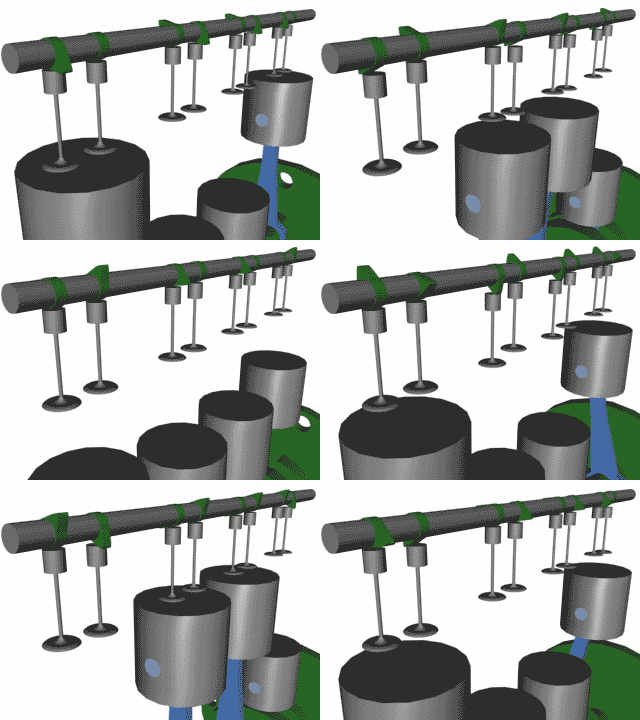
One of the
camshaft's most fundamental
tasks is to transform its
rotating motion into linear
motion or lift. This is
accomplished on a typical Chevy
V-8 with 16 lobes (an intake and
an exhaust)--all of them ground
to an eccentric shape called a
lobe to allow each lifter to
raise and fall above a base
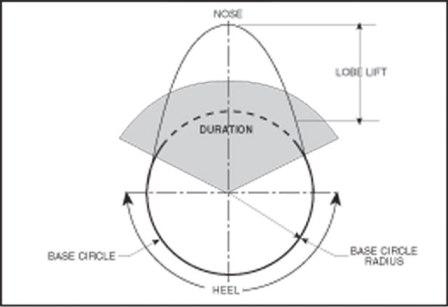
circle. Just how far
(mathematically) each lobe
raises the lifter is called the
lobe lift. The lift that is
typically referred to in a
camshaft catalog is the valve,
or gross lift, and is achieved
by multiplying the lobe lift by
the rocker arm ratio. For most
small-blocks, the standard
rocker ratio is 1.5:1, so, by
multiplying a theoretical lobe
lift of 0.370-inch x 1.5 rocker
arm ratio, we achieve a valve
lift of 0.555-inch lift (0.370 x
1.5 = 0.555).
By
replacing the standard rocker
arm ratios with a higher-ratio
rocker arm, you can add valve
lift and some duration. If we
use the camshaft with the
0.370-inch lobe lift and match
it to a rocker arm ratio of
1.7:1, we realize a gross lift
of 0.629 inches. Though these
two gross lift examples are
close to the upper end of a very
high-performance small-block
Chevy with a flat-tappet
camshaft, the mathematical
theory is the same for all
engines.
¡¡
¡¡
¡¡
¡¡
Duration
Camshaft Duration
Camshaft
duration is the amount of
crankshaft rotation that occurs
as the cam lobe moves the lifter
off of the base circle; it is
measured in crankshaft degrees
to make it easier to degree
(check) the cam to make sure it
is positioned properly in the
engine. Determining the specific
point that the lobe begins to
move, the lifter off of the base
circle (upwards) can be
difficult--so most camshaft
companies use a standardized
checking point to reference
lift. Consequently, the camshaft
industry has established a
common duration checking point
of 0.050-inch lift. As an
example, Howards Cams'
small-block hydraulic
flat-tappet Max Torque camshaft
(PN 112021) Chevy measures
222/232-degree duration on the
intake and exhaust, respectively
at 0.050-inch lobe lift, whereas
the advertised duration is
288/302 degrees.
Generally,
added duration is helpful in
high-rpm engines, but not
typically in low-rpm engines.
This is because the added time
that the valves are open in
high-rpm engines allows the
airflow additional time to enter
or exit the cylinder. But at
lower rpms, the added duration
opens the valves too long in
relation to the piston's
position in the cylinder, and
the pumping pressure is lost.
It's also
important to discuss the opening
and closing points of the
valves. The intake opening (IO)
typically occurs before top-dead
center (BTDC) and intake closing
(IC) occurs after bottom dead
center (ABDC). Exhaust opening
(EO) happens before bottom-dead
center (BBDC) and exhaust
closing (EC) after top-dead
center (ATDC). These points can
be checked by degreeing the cam
in the engine by degreeing or
simply referencing from the
information on the cam card
supplied with each new camshaft.
These values
can therefore be verified when
the cam is installed and
degreed. If you're not sure of
the duration of your camshaft
but have determined the intake
and exhaust closing points, you
discover the duration by adding
the opening and closing point
values to 180 degrees. For
example: if the intake valve
open value is at 0.050-inch lift
of 2 degrees and has an intake
closing value of 40 degrees, we
simply add both amounts to 180
(2 + 40 + 180 + 222) and we have
222 degrees of duration at
0.050-inch lift. This works just
as well for the ex-haust side.
¡¡
¡¡
¡¡
¡¡
Lifters
Camshaft
lifters, also called followers,
are offered in hydraulic
flat-tappet, solid flat-tappet,
hydraulic roller, and solid
roller designs. The hydraulic
flat-tappet is the most commonly
used largely because it offers
the benefits of quiet operation
and is available with most all
camshaft profiles designed for
either pure stock operation to
very high-performance
applications operating to about
6,500 rpm. Once a good hydraulic
lifter has been adjusted
properly, it generally remains
adjusted because of a
valve-controlled plunger inside
the lifter that maintains a
preload from engine oil
pressure.
Mechanical
(or solid) lifters are generally
used for applications where very
high rpms are
expected--typically to 8,000 rpm
or more. Although a solid lifter
has an oil-fed orifice, it is
still a mechanical lifter. To
allow for expansion that occurs
from varying engine
temperatures, mechanical lifters
maintain a certain valve lash
clearance at the rocker arm and
require periodic valve
adjustments.
Roller
lifters employ a small wheel at
the bottom of the lifter that
allows it to negotiate a very
aggressive lobe design with more
lift at a given duration and
reduced friction. Roller cams
are offered in both hydraulic
and mechanical designs in a
variety of performance profiles
and are typically more expensive
to install than the flat-tappet
varieties.
¡¡
¡¡
¡¡
¡¡
Single and Dual-Pattern
Camshafts
If you've
ever looked at a cam card
(furnished with each new
camshaft), you've probably
noticed that some cams have the
same specs for both the intake
and exhaust (single pattern),
while others differ (dual
pattern). A dual-pattern
camshaft generally offers more
exhaust duration to improve the
flow of an otherwise marginal
cylinder-head exhaust port.
¡¡
¡¡
¡¡
¡¡
Intake Centerline
The cam's
centerline specification is used
to determine the position of the
lobes on both the cam and as
installed in the engine. Most
cam companies include an intake
centerline number, which is the
position of the intake lobe
centerline (in crankshaft
degrees) relative to top dead
center on piston number one.
This can
be altered by degreeing the cam
after it's been installed in the
engine. Moving the camshaft from
its installed position affects
all four opening and closing
points; generally, the most
important is intake closing. So
by advancing the cam, the intake
valve closes sooner. While this
improves low-speed torque, it
compromises top-end power.
¡¡
¡¡
¡¡
¡¡
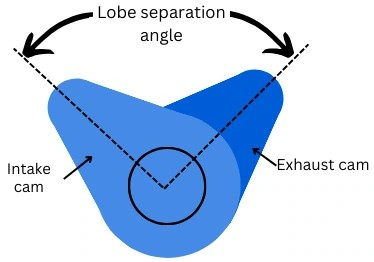
Separation
Lobe
separation angle (LSA) refers to
the distance or spacing between
the intake and exhaust lobe
centerlines. This value is
expressed in camshaft degrees,
not crankshaft degrees. This is
an important dimension because
it establishes the amount of
overlap between the intake and
exhaust. Lobe separation angle
(unlike the intake centerline),
can only be determined when the
cam is ground.
¡¡
¡¡
¡¡
¡¡
Conclusion
Choosing
the best camshaft depends on
vast criteria. If you use your
car for daily transportation,
you'll want to consider a
camshaft with shorter duration
and relative lift. NewCams
company offer copious assistance
to match the best cam with the
type of driving or racing you
do. If you're looking for
something wild, remember to
match the rest of your engine
and vehicle to your cam choice.
Transmission type, vehicle
weight, stall speed,
compression, cylinder heads, and
much more only begin the list.
In this section, we've only
touched on the fundamentals of
camshafts. If you'd like to
learn more, visit the some of
the cam manufacturer's Web sites
(www.camshaft.cc).
They hold a wealth of camshaft
knowledge that is ever-evolving,
and the tech sections of these
Web sites are packed with
information. Understanding the
basics of camshafts may be
difficult at first, but after
reviewing the information,
you'll find that you've learned
quite a lot. The knowledge that
you gain will surely help you
choose the best cam for your
particular engine.
¡¡
¡¡
Quick Links
Contact Info
Welcome to visit us
YuHuan
NewCams
Machinery
Manufacture Co.,Ltd.
We complete every process carefully and
provide the best service for
each vehicle.